No longer a moto-taxi novice!

No longer a moto-taxi novice!
No longer a moto-taxi novice! It can be exhausting but it's great fun!

Sunday, 6 February 2011

Overland to Zanzibar

Interior of Taqwa bus.

The journey really started the night before as we checked in at a small hotel ten minutes walk away from the bus departure point - I almost said bus station but that is too grand a term for the bumpy, rutted piece of ground where the long distance buses leave Nyabagogo, a suburb of Kigali, for destinations in neighbouring countries.  We woke up the security guard as we left the hotel at 05.00 in the darkness, carrying our rucksacks and bags of provisions for the 31 hour journey.  We reckoned about five meals worth of food as there was no guarantee we would want any food that was on sale at the roadside stops.  We also had toilet paper and a length of cloth with us for hiding when going in the bushes at the roadside, as we knew we would have to!
The bus looked quite reasonable in the dark under the limited lighting and we mounted the four huge steps up to the passenger deck to settle into our seats.  Luggage space was limited inside but we had heard that bags in the luggage part below us ended up covered in a thick layer of dust, so squeezed our stuff in as best we could.  Our seat near the front just behind the driver would give us quite a good view of the road ahead.

The bus roared off on schedule and we discovered that we had about four extra crew members cluttering up the space around us and the driver and that the door was wedged shut with a plank of wood in the stairwell.  It was just beginning to get light as we left Kigali and a cold draught rushed in through all the badly fitting windows making us glad we had sleeping bags to wrap up in!  We actually soon got used to the fact that this and every other driver on the journeys we made fully believed he was immortal and could drive his bus like a F1 racer!  The hooting of the horn made everything jump out of our way, pedestrians, bikes, cars, smaller buses - everything swerved to one side as we passed.  The drive to the border was uninterrupted by any breaks and we had to queue to get through the border formalities on the Rwandan side before we could get to the two single toilets just up the hill a little way.  We left the bus behind and walked across the bridge over the Rusumo Falls into Tanzania.  More queues for formalities as we paid our $50 and got a single entry visa.  By now the coach had rejoined us and we piled in to continue the journey.


Our bus at the border.
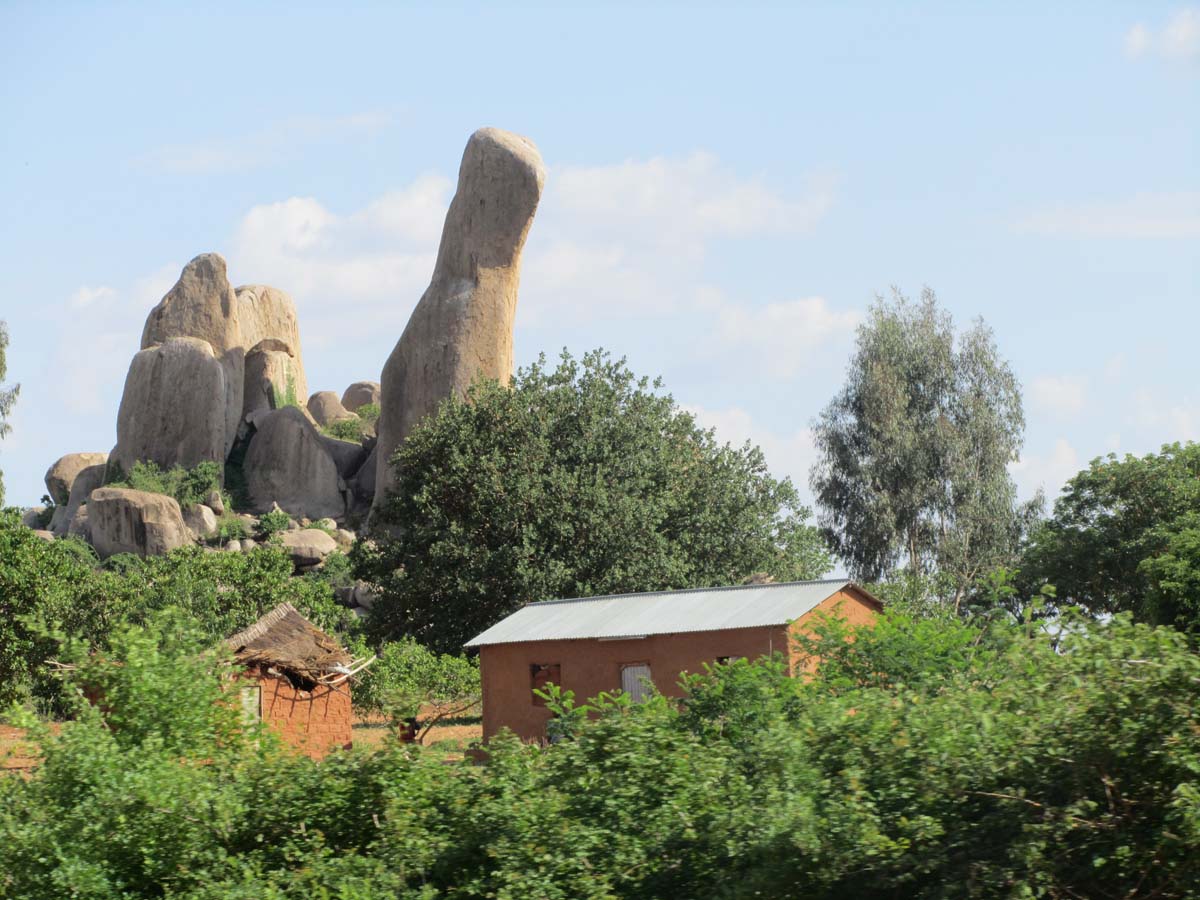
The scenery swept past us endlessly and the thousand hills of Rwanda flattened out into the Savannah-like scrub land of western Tanzania.  The journey was never really boring during daylight hours as we had an ever-changing landscape punctuated by villages and small towns sprawled along the roadway. 


Views from the bus.
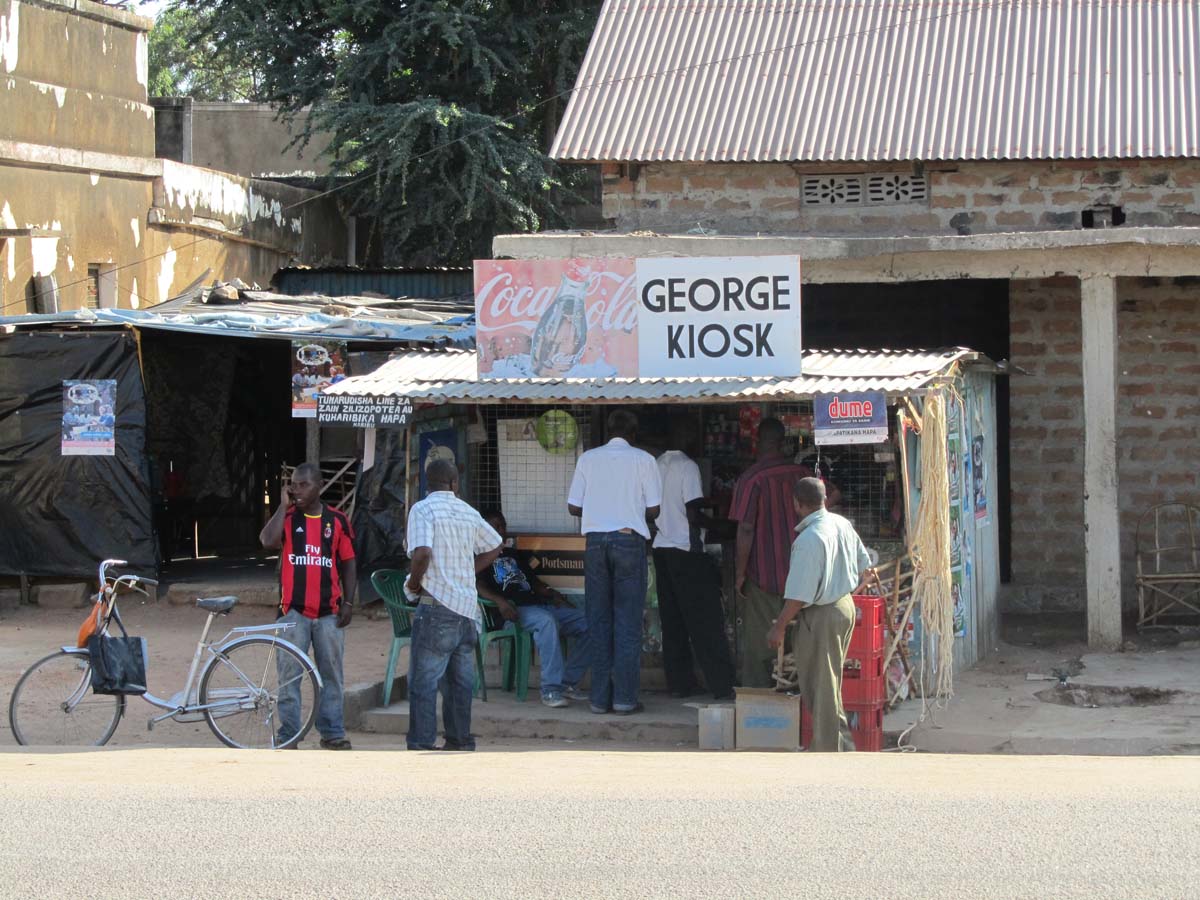
Roadside stalls


Of course there were several stops by the roadside in the middle of nowhere so that the mamas could go to the left in the bushes and the papas to the right!  Then there were stops at petrol stations and a small village where we could get fresh drinks and food, with a range of toilet opportunities most of which don't bear description here!  At one stop a couple of lads had a large charcoal stove where they were expertly frying chips in one wok before scooping them into a pan to make a kind of chip omelet served up in a small black plastic bag - actually quite tasty! The roadside stalls and shops were a constant visual treat as were the many people passing by.

The journey was less interesting as night fell but eventually we stopped for a three hour break around midnight in a small town with several bars and restaurants.  We headed for the most salubrious looking one and had a drink, or some food while the driver took his rest.  I believe that buses are not allowed to travel for parts of the night for safety reasons - highway men or road safety, who knows, we could believe anything!  I forgot to mention that the gangway of the bus was full of extra passengers sitting or lying on the floor all the way to Dar es Salaam and I needed to keep my legs and arms jutting out to keep my personal space reasonably free.

The next day was much the same, punctuated by regular police controls of the buse's' papers and visits to the weighbridge almost every two hours. 

Weighbridge sign


Finally we reached Dar es Salaam and disembarked into the chaos that characterises all bus stations - a scrum of taxi drivers, hawkers, hotel touts all vying for our attention.  We managed to elbow our way through and located an official taxi with a driver who agreed a reasonable price to take us the 8 km or so from the suburbs to the town centre hostel.  Some of our group rushed straight off to the ferry terminal to Zanzibar, but we wanted a rest first, so we could enjoy the ferry crossing better.  The Jambo Inn Hotel is a kind of back-packers hostel with a combination of dorms and private single or double rooms with air conditioning - much less bad than I had expected and they had a restaurant, internet cafe and a small shop.  After lunch we set off to buy our tickets for the fast catamaran to Zanzibar.  Another scrum around the terminal but eventually we got what we wanted.  There are dire warnings in the Lonely Planet guide about personal safety in Dar es Salaam, so we were really careful, especially around the bank ATM and as darkness fell.  In fact we never felt unsafe all the time we were in Dar and the people were friendly and helpful.  We were amazed by the shops and supermarkets we visited, which could almost have been in a European or American city, on a smaller scale.  We suddenly realised how far behind Rwanda is in the availability of goods, compared to back home.  We even found an out of town shopping mall, very similar to back home, though we had to take a dodgy bus to get there and taxi back to town.

Dar from the sea, contrast of modern and old.


The ferry terminal the next day was packed and we just had to join the scrum waiting impatiently to board.  We had allowed ourselves the luxury of first class accommodation in the spacious  air-conditioned lounge and we were so pleased to have spent the little extra to be there in comfort when we saw the rest of the boat overcrowded with many passengers siting on the floor.  We had great views of the harbour as we left and as we arrived in Zanzibar after a a calm, sunny crossing.

Arriving in Zanzibar

Although we had a good idea of where our hotel was we could not avoid being pestered by one or two local "fleas" or touts.  By the time we shook  them off we really were lost in the labyrinth of tiny lanes in old Stonetown and had to get help.  We later learned that those guys get commission from the hotels they take you to and we should have just tagged along and let the hotel pay the tip!  Loaded with baggage you're a bit vulnerable in a strange town.  Later, wandering around without luggage we felt perfectly safe and were hardly bothered.


That's our hotel with the yellow sign!


Although the hotel looks nothing from the outside the rooms, upstairs from an interior courtyard were lovely.  The roof was an open terrace where breakfast was served, with great rooftop views.  I can recommend the Hotel Kiponda - it's mid-range, not too expensive, very central, clean and friendly.


The next day the hotel manager helped us hire bikes to explore the town.  That was fun and we covered a lot more ground than on foot, though we parked them up to explore the old market.                      
                                          This is the old fishing boat port and market.

Old market in Stonetown


Across Zanzibar to an East Coast Beach

Paje Village
The journey across the island to Paje was very easy - in a sharing private minibus.  We were able to see the interior of Zanzibar and contrast it with Rwanda. It was fairly empty, much of the land was uncultivated and the small villages looked really poor.  We soon realised on our arrival that beyond 100 metres from the shoreline, where the guest houses are located, the local people are living in very poor housing. 


The guest house we stayed in, Ndame Village,  is now owned by some Germans, having been established by a Dutch couple.  The same seemed to be the case for almost all the tourist accommodation along the shore and clearly not much is going back into the local economy. We saw a few fishermen with their small sailing boats and also women collecting seaweed from enclosures they had formed on the beach at low tide.

Our small holiday village was in  thatched huts along the shore, all with sea views, with a bigger hut for a pleasant dining room and a separately owned beach bar.  It was very quiet - some guests had been held up by the snow in various European airports.  The beach, as you will see from the photos was very shallow and sandy and during the day when the tide was out until mid-afternoon, the sea was about half a mile away on the horizon near the coral reef.  When it came up over the hot sand it was like a warm bath with waves!

Plenty of space for this!


There was little to do other than relax, stroll, swim when the sea was near and, when it wasn't, I was able to fly my kite!
....and this!


Christmas day was very quiet and strange - listening to American Christmas favourites coming from the bar - the same CD all day!  There were so few tourists that neither Christmas eve nor Christmas day had much atmosphere.  There was a small show of traditional singing and dancing from some Masai tribes people who worked around the area, mainly as security guards ( I guess their long traditions of watching over cattle herds stands them in good stead for keeping watch). Of course Zanzibar is a predominantly Muslim island, so Christmas has no special significance for the most of the local people. Where we did see decorations it was evidently for the tourists. 

So on the day after Boxing day we set off by taxi to head back to Stonetown to take the ferry back to Dar es Salaam.  The return journey was smooth and uneventful and we quickly found ourselves in the bustle of Dar ferry terminal avoiding the taxi and hotel touts to pick a taxi to take us back to the Jambo Inn. The staff there were very helpful in showing us where to get our bus tickets for the next leg of our journey.  The Dar Express office was close by the hotel and we managed to get virtually the last two seats for the following day.

Comfort stop. Miles from everywhere!
Once again we had to make our way to the out of town long distance bus terminal by taxi in time for an early departure.  The coach was the best one we travelled on - it had air conditioning, a hostess serving soft drinks and no extra passenger crowding the aisle!  We were heading for Arusha near the northern border with Kenya and not far from Mount Kilimanjaro.  The journey was scheduled to take 12 hours, but in fact lasted 15!  We had arranged to go to the office of Sunny Safaris, to pay for our safari and be taken to our hotel.  Of course the late bus meant that we arrived long after the office had closed and in the dark.  We had called the office and they kindly arranged for a driver to wait for the bus and take us to the hotel, where we would be collected the next morning to go to the office.  The hotel we chose seemed to be in the town centre according to the plan in the guide, but it turned out to be the business centre, with no cafes or restaurants open at nine o clock, when we were finally able to look for dinner!  Not an auspicious start to our stay in Arusha!


Road side stalls in Tanzania

The next day Sunny Safaris did not let us down and we were driven to their office to complete the formalities and meet our driver/guide and the cook. The safari vehicle was loaded with our bags along with the tents and supplies for three days.  We headed for the Tarangire National Park for our first day of wild life spotting.  It was a good day with a fair number of animals to be seen, but the park was very busy when we arrived there near lunch time.  Our cook had prepared a lunch box, which wasn't bad and we started our visit at the picnic area overlooking the river valley.

Outdoor stained glass panel at Tarangire National Park
One of many magnificent baobab trees in Tarangire

The park is well known for its baobab trees and there are many fine specimens.  At the entrance some lovely stained glass pieces depict the animals and landscape, including the baobabs.  The main sightings of this day were herds of elephants and giraffes.  The one lion sighting was too far away to photograph.  The scenery was very beautiful, but there were too many other vehicles queueing to see the wild life.
Elephants, Tarangire

Zebra, Tarangire


In the late afternoon we drove to Twiga Lodge camp site, where we sat watching on chairs as the helpers erected our tent.

The camp site was just like a European one, tidy lawns with trees and shrubs, a large toilet block and a cooking area, where the various cooks prepared an evening meal for their clients.  The food was quite good, but the cook clearly did not understand the concept of being vegetarian and kept on producing meat dishes. His basic English didn't help him understand our explanations.  To add to his problems with us he slept in the following morning and delayed our departure - in fact we insisted on leaving without breakfast since we wanted to get to the Ngorogoro Crater before the crowds.  The cook sulked for most of the rest of our safari, but he did try to make up for his mistake. Our driver was upset too, as he seemed to think we blamed him as well.  In fact our driver had turned out to be a very knowledgeable guide, who spoke good English and was able to give us a lot of information about the places we visited and the animals we saw. 

Hyena checking out the flamingos in Ngorogoro Crater lake
The Ngorogoro Crater is a beautiful park, part of which is still used by Masai herdsmen for their cattle.  The crater has a lake near the middle, but it was very dry and distant from the tracks.  You could just make out a pink line, which was the flamingoes.  We saw herds of zebra, ostriches, jackals and hyenas, elephants, lots of buffalo and various gazelles and a good number of lions, quite close up as the photos show.

This is his pride!
The scenery here is magnificent and the Ngorogoro Crater National Park is worth a visit for that alone, but we were lucky to see a great number of animals in spite of the many safari vehicles in the park.

Baboons, Lake Manyara.
Lake Manyara was the destination for the third day. The park has a large group of baboons, which gather around the entrance road and entertain the visitors. We arrived early and were able to visit the hippo pool before anyone else arrived.  Unfortunately the hippos were not performing that early and it was only on a second visit later that we really saw them swimming and on the land beside the pool.  We saw more giraffes, elephants, buffalo and gazelles, zebras as well as the hippos, but no lions that day!


Yes, he's got my bag of crisps!


We got back to the campsite for lunch, packed our bags and set off back to Arusha, where we had booked a better hotel for New Year's Eve.  On the way we stopped at about four craft shops because our driver ha explained that there was a raffle being held that day with a first prize of a course at the school for guides.  The more often he had his card stamped at a craft shop the better chance he had of winning the prize.  He had been a good guide for us so we played along by popping into the shops for a quick look.  I don't know what they do with the mountains of carvings, masks, statues, baskets, jewellery these shops have on display.  There were very few tourists at this time so some sellers were a bit pushy or maybe desperate?  There is little original work, even the paintings look as if they were produced in a factory of painters, working on a production line.  in the same way the wood carvings are all similar and there is very little pottery to be seen in these kinds of shops. I guess they have to make what they think tourists will buy as their own people are too poor to be able to afford arts and crafts, except for utilitarian needs.

The first hotel we stayed in at Arusha was so badly located and offered no evening activities at all so we decided to splash out and go for one of the best hotels in town - the Hotel Impala.  It was very comfortable and, even better, offered four different restaurants, from local to Chinese and Italian!
In fact for New Year's Eve they had combined all restaurants into one, based around the swimming pool out of doors. For a moderate price they were offering a range of dishes in a buffet, covering all four restaurant specialities.  Sadly it was a little cool out of doors and the DJ did not really manage to get much atmosphere going.  There seemed to be a good number of local wealthy families who were celebrating there but most people left a good hour before midnight.  There was a show - local dancers and then trio of acrobatic, juggling, fire eating, dancing and singing young men, who did their best to get people into a cheery mood. However, it was all rather like seeing street performers in York!  I had hoped for something more traditional - I guess the locals would prefer the more western-style show.  It was so cold we gave up at about 11.30 and heard the brief firework show from bed, trying to get warm!

On New Year's Day we were picked up from the hotel at 08.30 prompt by the driver/guide from Peace Matunda.  This is a local NGO set up by a young man called Kyaa Matunda, using his parents' land and house to create an orphanage and a school for mainly Masai children.  They also specialise in local culture tours and take young volunteers from a charity in England to work with the teachers in the school.

Kyaa standing beside a traditional hut in front of his new house


On arrival at their compound we were introduced to some visiting Masai relatives, who had come to see children who lived in the orphanage.  The school was closed for the holidays of course, but we met some of the young volunteers. 


 After coffee round the communal table in the large living area we began our tour proper with a demonstration of how raw coffee beans are turned into a pot of coffee, using traditional tools and a charcoal stove.  We were amazed that we finished up with a very good cup of coffee!
Pounding the raw coffee beans to remove the husks.

Roasting the beans.


Enjoying the fresh Tanzanian coffee.

Next we were taken on a walking tour for about two hours looking at banana plantations, local houses and villages and a great view of the hills and valleys just outside the Mount Meru National Park.  Our guide spoke excellent English and told us a lot about the local way of life.  We found, to our astonishment that any older people who met us were so pleased and excited - apparently it is really lucky to meet a white person on New Year's Day - so we brought some small pleasure into one or two lives!  We passed several churches, which were full of beautifully dressed people celebrating the new year with lively gospel music, enthusiastic sermons and prayers.  We later found that there is virtually no other Tanzanian music available in CD shops and stalls other than gospel.  Any other style was from other African countries. 

Our walkabout guide.

After our tour we went back to the orphanage and enjoyed delicious local food with two of the guides, in a palm leaf-thatched hut. The menu was typical of almost everywhere I have been to eat - rice, kidney beans, greens, plantain and sweet potatoes and meat stew with lots of sauce for the mountain of carbohydrates!  It was all very fresh and tasty of course and was followed by fresh fruits. 

Kyaa, the founder of Peace Matunda then came to join us and took us on a tour round the establishment.  We met his mother who still lives in the family house, within the compound with her small farm yard (cows, goats, hens) and looked around the almost finished new orphanage building of which he was very proud.  Justly so - it was bright, colourful and built to really good standards.  There were separate boys' and girls' dormitories with showers and toilets and new furniture everywhere.  All this was done on the proceeds of the tours, including safaris, which they offer, some profit from what the volunteers pay for their keep and of course aid from the British charity they work with.  It was impressive to see what one determined young man could achieve with a vision and a lot of hard work.  He had created an orphanage, a growing school, a tour business, a volunteer service and provided employment for local people as well, all in a matter of five or six years.  Google "Peace Matunda, Arusha"  for more information!


Our afternoon continued with a ride down the hill on very ramshackle  mountain bikes to the local village market.  The bikes were left in the care of a local while we explored the market with our guide.  He showed us inside a corn mill, a local restaurant kitchen and a variety of shops and stalls.


Typical pots and charcoal stoves in the market.
Around five o'clock we were picked up by their mini bus and transported to our hotel to relax after a really interesting and varied day.  On our way the driver kindly helped us book our tickets for the onward journey by bus to Mwanza.

Needless to say the long distance Mwanza bus departed at 06.00, in theory, but was of course late arriving and leaving!  This bus was really old!  It had no air conditioning, but the windows couldn't close, so we got plenty of breeze.  Unfortunately well over half the route was on dusty earth roads zig-zagging between the roadworks and excavations, frustratingly alongside the almost finished new road!  We found a new use for the lengths of cloth intended for roadside toilet visits - namely to cover ourselves up to keep some of then dust billowing in the windows off us.
The bus to Mwanza from Arusha

No, they are not getting off - they stood there for hours in front of me!

On arrival at our hotel in Mwanza - very much behind schedule as usual, we were caked in sweaty dust from head to foot! What an experience!! Dusty, bumpy roads, crazy speeding drivers and the mechanical staff and extra passengers in every free space between the seats and around the driver. Not an experience I wanted to repeat….. but we were still a long way from Rwanda and there was more to come!!


 The hotel in Mwanza was very comfortable, we negotiated a good price when we said we planned to be there for four nights and indeed got an upgrade to a small suite!  We could see Lake Victoria from the side of one of our balconies, but had a beautiful view, especially at sunset, from the fifth floor terrace bar.


Mwanza is definitely not a tourist town - the hotels are for business people, conferences and meetings, so there was not much of a holiday atmosphere anywhere in town.  On the other hand there were hardly any white people to be seen at all, yet we were hardly bothered.  There was no hassling from market traders, shop keepers, ticket touts, taxis, beggars at all.  The town felt safe even in the evening when we went out to eat for a change from the hotel.  Although lying on the bank of the Lake Victoria with two commercial harbours, there is little access to the waterside and no pleasure craft other than one small excursion to an island bird sanctuary.  To find a beach you need to travel some 10 km out of town and even then the water is risky for bathing because of bilharzia.  In fact we found the town itself so interesting, as a "normal" African town, that we were not tempted to seek out the beach.  One high range hotel near the town, the Hotel Tilapia, has a swimming pool, which can be used for a fee, by non-residents but after eating lunch there we were put off by the wealthy whites who frequent it!

Part of the extensive second hand shoe market in Mwanza.
Mwanza seems to be the second-hand shoe capital of Africa.  The market has a huge area devoted to the cleaning and refurbishment of shoes, presumably from charity collections in developed countries.  They literally wash all shoes, leather included, in soapy water, dry them in the sun then apply appropriate polish or colours to make them look like new.  It really is amazing what they achieve.  You can find every style of shoe from the last five years or more made by Caterpillar, Ecco, Timberland, Nike, Adidas, Rieker, Moda in Pelle, to name but a few I can remember seeing, all refurbished and selling at quite high prices - well above what we would expect to pay for the same thing in a charity shop in the UK! 

Young man washing second hand shoes.

 Of course the same applies to all types of clothing across Africa.  Here in Rwanda at least 90% of clothes on sale, especially in the markets, is second hand.  There are new clothes and shoes to be found in Kigali in a few westernised shops.  Of course the traditional clothes most women wear, especially outside the capital, involve colourful lengths of cloth called "panga", which they can have made up into dresses or skirts if they don't want to simply tie them round the waist.


We knew that getting back to Rwanda would be somewhat problematic from this area, as no buses cross the border.  The nearest we would be able to get was to Benaco, about 20 km before the border and we would have to get a taxi to the border.  We found the bus office in the depths of the town and found that we had been given false information two days before by a tout.  He had said that we could get a bus right to the border and told us the wrong bus company.  Fortunately some more helpful guys got us to the right place.  However, when we insisted that we wanted to pay for three seats in order to keep our bags with us the ticket seller took a lot of convincing.  He must have thought we were mad to pay £8 for a seat for our bags. In the end he agreed and we found out where the bus would leave.  As ever the long distance bus station was actually on the edge of the town and we needed a long taxi ride in the early morning to get there. 

Shortly after setting off from Mwanza, we were alarmed to find the bus in a queue to go on a ferry over the lake.  We knew that some buses took a three-four hour lake journey to a town further north and were worried that we were on the wrong bus. Frantic questioning of other passenger to find English or French speakers brought us re-assurance as the ferry was just crossing a small inlet in the lake and we arrived on the other side in about 20 minutes. It's amazing how panicky you can get when you are setting off into the unknown and things don't turn out as expected!! 
Waterside scene near ferry over part of Lake Victoria

View over Lake Victoria from Tanzania.


Our seats were just behind the driver so we had a hair-raising view of the road ahead.  It was not long before the tarmac ran out and we found ourselves racing along like Louis Hamilton in the middle of a mud track, with dust flying in all the windows and the wide open broken door! 
More disconcerting was when armed guards without uniforms escorting a group of young men, whose shirts were all tied to each other, got onto the bus and settled them on the floor in the aisle.  Two more machine guns followed!  We have no idea whether they were prisoners, refugees, terrorists or whatever else, but we were glad when they got off an hour or so later without incident.  A little later four more civilians with machine guns got on and travelled a few miles with us (no money changed hands for fares!).  We felt more and more that western Tanzania is like the wild west once was.
Wild western Tanzania.

There were frequent weighbridge and police controls, where standing passengers were counted.  In some cases the excess passengers had been taken off onto  a mini-taxi a few kilometres before the control and then rejoined the bus further down the road.  What with the guns, the extra passengers, the dusty tracks and the speed it seemed like a miracle that we were able to get off in one piece at Benaco. 

Benaco hardly qualifies as a village, but we were soon surrounded by taxi touts persuading us to get into a shared taxi to the border.  We agreed, but on finding they planned to squeeze seven plus luggage into a five seater saloon of dubious mechanical condition we leapt out grabbing our bags and beat a hasty retreat towards the border.  We found a less pushy taxi driver who agreed to take us to the border for a rather higher fare of course, but at least we had the car to ourselves.  It was an old automatic and he set off like a bat out of hell with us shouting "pole, pole!" from the back.  The little Swahili we had picked up fortunately included "slowly, slowly".  The driver laughed and slowed down for a little while.  The car was running very badly and I'm sure he didn't understand the gear box - at times he seemed to be using reverse to slow the car down!! Once again we were so glad to arrive unharmed!  In spite of the heavy rain, which had begun to fall, we jumped out quickly and rushed towards the border post.  Amazingly we had arrived long before dark, when the frontier is closed and we crossed quickly into the rain and thunder of Rwanda - what a welcome!  Of course the Rwandan guard wanted to search our luggage for plastic bags.  My friend had hidden them all in a secret pocket and I thought I had none.  We explained that we worked in Rwanda and knew that we could not bring in plastic bags and he relented (or couldn't be bothered) when we were so nice and friendly. I later discovered that I had forgotten about one plastic pocket I had some documents in.  They only confiscate the bags, nothing serious happens!

A few minutes later, we sat in the relative luxury of a good old Rwandan Coaster bus in the rain while we waited for it to fill up with a few more people.  By the time we arrived near Nyakarambi it was choc-a-bloc and we were glad to struggle off with our rucksacks and walk up the street to my house.

All in all an unforgettable journey, which more than made up for the lack of gap-year experience in my student days.  I'm really glad to have done it as Tanzania has a lot to offer in the way of sights and activities. It is more developed than Rwanda and so consumer goods are more available in the big towns.  Yet the last stage of the journey revealed a really poor western part of the country, where we felt the dangers of armed robbers mentioned in the Lonely Planet guide were a real possibility.  Unlike Rwanda there is no concern for the environment in Tanzania and there is litter and waste to be seen everywhere, especially plastic packaging.  The people we had dealings with were friendly and welcoming and we got generally quite good service wherever we went.  Of course the buses have to be in the last section - I thought Rwandan buses could be mechanically rather unreliable, but in the main they are controlled and regulated for safety.  Tanzanian long distance buses are clearly much less regulated and the controls are simply flauted.  As I said, I'm glad to have done the journey overland but even more happy that we survived it!  Future journeys in this huge continent will definitely be by air, in spite of the really high fares!


Tuesday, 23 November 2010

The Rainy Season

Filling containers from overflowing gutters.
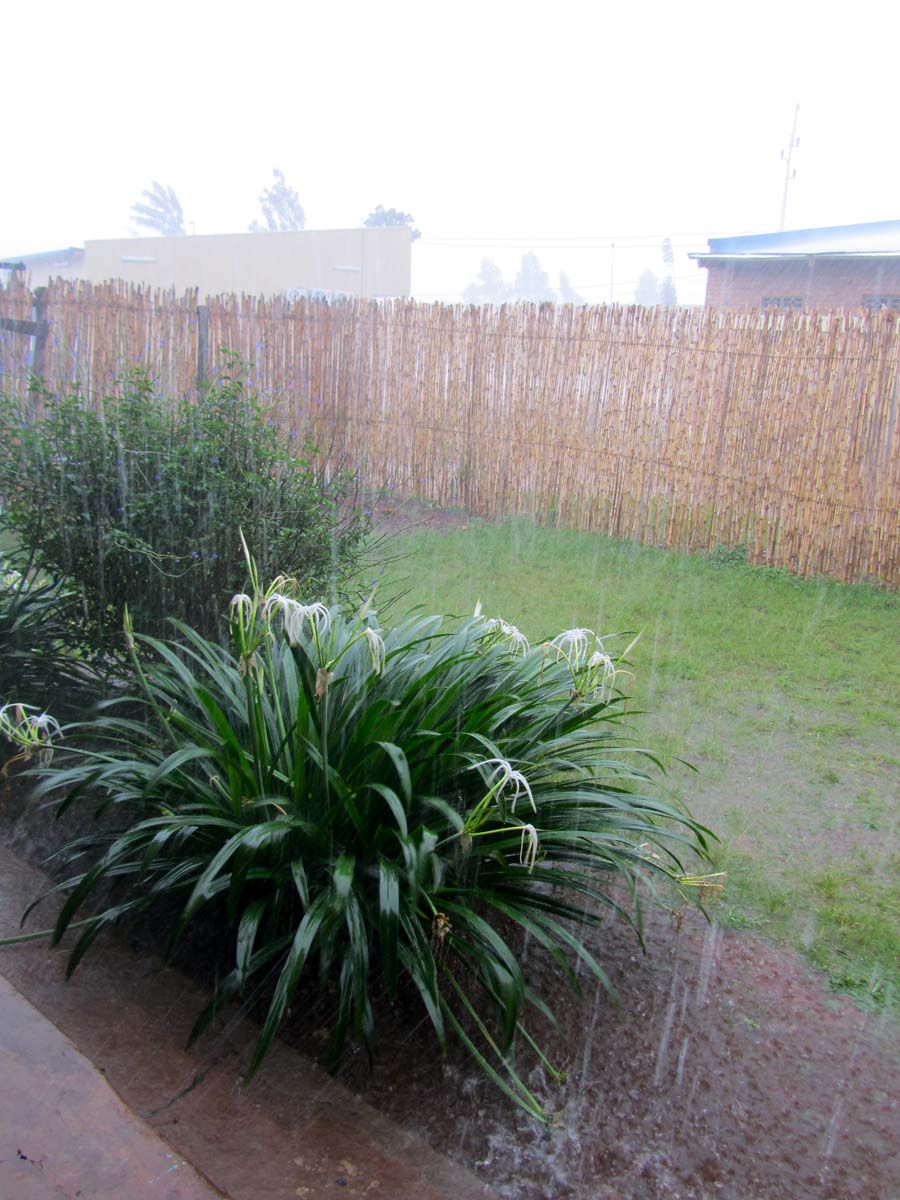
The rainy season is really letting rip now.  Today we had grey skies all morning then after lunch the heavens opened with a vengeance.  The wind sprang up too, so that the house was battered with heavy drops of rain.  The roof gutters overflowed everywhere and Dignite tried to get all the water containers filled with free water!

The orange tree is covered in little oranges which will probably benefit from the rain.    You can see my personal electricity pole too!

The front garden becoming a paddling pool!


Sadly today was market day and many traders must have got soaked and perhaps had their goods spoiled.  After the storm the people emerged from wherever they had found some shelter and gradually the market came back to life.  It's quite amazing how the roads and streets empty as the rain begins.  Life just stops temporarily as any coat or umbrella is far from adequate to protect you from such torrents.  I did eventually get myself an umbrella for lesser rainfall and tend to carry it, heavy as it, is as a kind of talisman against it actually raining on me. Many Rwandan women use an umbrella a lot, but as a parasol, especially if they are carrying a baby on their back.


Recently I hopped on a bus with a friend just as it started to rain.  We were in Kigali heading for the big market just outside town.  When we arrived at the terminus in torrential rain the bus simply stopped and nobody moved to get off, except the stupid "muzungos".  However, the conductor made it clear that we should stay as he shut the door firmly and the driver slumped over his steering wheel for a sleep.  Every mini bus that came in drove as near as possible to the shelter so that those foolish travellers who wanted to could rush off,  but most people just sat and waited until the storm had passed. 

The temperature has dropped quite a lot after today's soaking and I needed to put on a fleece even in the house for the first time.  I'm wondering if I should go and look for some wellies!  Amazingly the electricity did not fail, though I'm probably tempting fate by writing that!


Of course the un-surfaced roads just become impassable for vehicles when it rains hard.  The stones become really slippery as they are covered in a coating of mud and moto-taxis simply refuse to start a journey.  I've been lucky so far that my moto trips have only had a light sprinkling which hardly wet my visor and it was on a tarred road.  Even there the layer of dust turns into a treacherous slimy mud.  I'm really fortunate to have such a skilled driver in Daniel - I'm sure he could win motocross trials or races in the UK!  Any thoughts I entertained about getting a licence to drive myself have long ago evaporated, as I've seen how difficult many of our journeys have been for Daniel.

  
Daniel went shopping at the lake while I visited a rural school.  At the next stop he had it chopped up and cooked ready for dinner! 


Monday, 22 November 2010

Some little people, that is my grand children have asked for more information about my house - especially inside.
Well, I've got some new photos, which show the interior.
The first two show the living room with pretty standard VSO furnishings.  THe room is pleasant enough when the sun is shining, but the windows are so small that it is rather gloomy when the sky is grey or evening is falling.  I've ordered some pictures form the cow dung painting co-op, but they are not ready yet.  Many volunteers hang lengths of African cloth on the walls, but as I am expecting a new housemate in a couple of weeks, I decided not to fill too many walls just yet.  At the other end of the room is the door to my bedroom and you can see my gallery of Pugh family pictures on the walls.


In my bedroom the three-quarter size bed has a mosquito net over it, which covers the bed at night, though I have seen very very few if any mosquitos since I arrived here. It's better to be safe than sorry!  Dignite makes the bed each day in an amazing variety of different styles of folds. All bedclothes here in Rwanda are brightly coloured, plain is almost impossible to find.


In the indoor kitchen, one photo shows the food and crockery shelves, which have stuff going back to previous volunteers who have lived here.  The plates, dishes and pans are all of Chinese origin and feature lots of flowers ugh!  In the other photo you can see the water filter and thermoses which Dignite fills with hot water each day, some for tea and cooking and another for washing (in fact a basin shower, using a small jug). You can also see the dodgy solar panel system, which in fact comes into its own quite often as there are frequent power cuts each week.  There is usually enough stored solar power to get the lights on during a mains cut., though I'm glad not to have to rely on its limited capacity every day now!

The photo below, with Dignite, shows her working in the outdoor kitchen, which is where she cooks on a charcoal burning stove (front left) and a kerosene stove.  Both are pretty smelly so it is best to keep the cooking in the separate building.  Dignite, like most Rwandans does everything at floor level - there is no such thing as a kitchen work top in most houses. However, I have seen a couple of hotels with suites that feature an American style kitchen.


The last photo shows the shower room/water room.  As you see the shower is just a base which drains through the wall into the garden gutter.  The various buckets and jerry cans hold delivered water or rain water collected from the roof. After a shower the water, which is left in the basin, is used to flush the outside toilet, as there is no water supply there.


It's all pretty basic and rather rough and ready.  The house walls are mud brick coated with a thin screed of cement inside and out.  If you want to put up a clothes rack, you use six inch nails straight into the wall at an angle.  Needless to say they come loose often, which is why every room has a scattering of holes of every size from previous fixings.  When the house was decorated recently the painter just painted across the holes and did nothing to fill them.  Even the man who plastered over the newly chased in electric cables ignored holes only centimetres away from his task. The decorator also painted straight over many blobs of blutack left when he took down any pictures!  As you've seen every room is the same colour with dark brown painted doors and windows and a black band around the base of the walls.  The cement floor is often washed down so the black gloss paint protects the walls. Unfortunately the ceilings are plain darkish plywood so make the rooms dark.  Having seen the slapdash way the walls were done I dread to think what kind of mess would happen if I wanted the ceilings painted!

Imogongo Art Co-operative


Here is a photo of a couple of pieces of Imigongo art (that's the cow dung stuff).  On the left a traditional style one, always with black and white geometric patterns and on the right an example of the modern art pictures they have started doing in recent years, probably for the tourist market.  The raised pattern is done with the cow dung mixture, used just like clay or plasticine and the traditional ones have natural pigments and fixatives. You can see a young woman applying the texture design to the wooden backing  board . I suspect that the modern designs use Rwandan emulsion paint!  When I go to collect my pictures I'll try to find out more, especially as I want to get some of the cow dung mixture to have a go myself.  It doesn't smell even when damp, so they must treat it in some way.  More details later for the artists among you!  I need to go with a KInyarwanda interpreter so I can find out more.  The women there don't speak French or English and there's only so much you can do with signs.

One last picture snapped as I was waiting for a bus in Nyakarambi.  The bus comes from Rusumo, where the River Akagera goes over the waterfalls at the Tanzanian border.  The driver evidently took advantage of the trip to bring home a couple of river fish!

Monday, 18 October 2010

One month on - October 18, 2010

Beach at Home St Jean guest house, Lake Kivu

Sunrise on Lake Kivu
 One pleasant weekend was spent in Kigali, apart from the dubious delights of a budget hostel run by a church.  The surroundings were pleasant enough and it's right in the town centre, but the bed was really lumpy and uncomfortable. However Kigali is very nice on Sunday - very quiet, and a good breakfast can be had in lovely gardens at the Karibu Restaurant.  The biggest surprise was to get home to find that an electrician had started re-wiring the house ready to get connected up to the mains supply - they had even cut channels in the walls to conceal the cables, and replastered.  The place looked a mess but at least something was happening - the rent must have been paid!  A day or so later we got home to find the whole inside of the house had been re-painted!!  Not quite the finish we'd expect in the UK but at least it all looks clean and fresh.  In the next few days all went quiet apart from occasional tinkering and now four weeks later all has gone very quiet, though Maman Jonathon, my land lady, called today to say that all the applications had been made and we just have to be patient!

Towards the end of September I met a group of teachers from this district who are going through the complicated process of applying for a Global Schools Partnership link with a UK school and then completing a form for a reciprocal visit grant.  They are all really enthusiastic and were also saying goodbye to my predecessor who had given them so much help. VSO is holding a workshop in Kigali this weekend to help them with the forms - needless to say I'll be looking for different accommodation!
Nursery Class - notice the concrete benches!


Children from village near lake in Mpanga Sector
Notice the young girl carrying a baby sibling - a common sight, even in the nursery class picture above here.


Home St Jean, Lake Kivu
My room at Home St Jean, with lovely lake view
Lakeside School in Mpanga sector,  notice the planted gardens.

The early days of October were filled with handover meetings with my predecessor and visiting schools she had worked in over the last year to see what can be achieved. There were of course several farewell parties, including one in Nyanza, where we both have volunteer friends.  The town of Nyanza is much bigger than Nyakarambi, but the edge of town where they live is a big contrast with the town centre house I have, the former being very quiet and mine being relatively noisy from about 5.30 in the morning!  Nyanza was once the home of the Rwandan Royal family until 1961 when the monarchy was abolished.  His new palace, is currently a Modern Art Museum, offering annual prizes to Rwandan contemporary artists.  The displays would not have been out of place in any western art gallery, great carvings in wood, stone, and multi-media as well as paintings in many styles, again often using a variety of media.  Very much worth a visit - I was really pleasantly surprised.  The old Palace has been renovated as a museum, but it was too far away to visit on foot that afternoon.

On the way to the museum we passed a group of drummers practising in the open air.  On returning from the museum they had been joined by a large group of traditional dancers, who were rehearsing.  Although they were in casual clothing and not performance costumes it was very good and we felt privileged to have been allowed to watch for a while.


Schools are currently revising for the national exams and school exams as the school year finishes at the end of October.  Teachers then have November for training generally and December for English training for all teachers, provided by the government in a huge logistical operation. The compulsory training finishes on 24 December!! That is after a year of double shifting (one half of the school in the morning the other half in the afternoon) and teaching everything in a foreign language! There is no doubt that Rwandan teachers have a very hard life.  In addition many spend the weekend at Uni trying to get extra qualifications so they can see slight increase in their salary (Teachers' salary is about £30-£35 per month!). We have made five full day visits to Mpanga and will be going back often in the new school year.  Yesterday we had our first rain moto experience - luckily not the usual deluge but a steady light rain as we drove along.  Even so we got a sense of how impassible the dirt tracks will be when it really rains hard - the clay makes everything very slippery under the tyres - not a nice sensation!

I have included some pictures from a lakeside village near one of these schools.  The poverty is self evident, but they still give us big smiles and get excited to see rare white people in that area.
In contrast there are pictures from a school only half an hour from here which has benefitted from a good deal of VSO attention and has set up flourishing after school clubs for Science, English, Music and Dance, Environment and recently Media club, based around a donated digital camera and the school's one laptop.  They have a computer room with cloth-shrouded donated desk top computers - but no electricity! You will see the basic Science materials using plastic containers from all kinds and household chemicals and ingredients. They have made soap to use in school, paint for one room and are planning to make foam mats for sport when they get the materials!

Last weekend some of us went to Lake Kivu in the West of Rwanda, to the little town of Kibuye.  We found a beautiful and comfortable budget-priced guest-house, which is on a headland overlooking the lake.  It has  a terrace restaurant and bar and gardens going down to a rocky small beach from which we were able to swim - it was great, lovely water and fantastic views.  The staff are really welcoming and friendly too. If any of you come to visit that will certainly be worth the trip, 6 hours by bus!! - but through wonderful scenery.  Kibuye is a destination for Rwandans and there are very few white tourists, so it is fairly quiet.
As well as the pictures of the lake I have included one of local children collecting water from the water's edge and some fishing boats.

I got home yesterday after an hour's moto ride to find my house surrounded by an excited crowd.  MTN, one of the mobile network providers had parked their road show right outside my garden and were blasting the whole town with music and adverts for mobile phone air time. It was market day, just next to the house, so they were sure of getting a big crowd.  Luckily it stopped at about 17.30, as the market packed up.  You can see my house roof in the picture behind the MTN lorry!

MTN Roadshow - my house behind!


Last weekend I had two meetings to attend in Kigali, so was there for three nights.  This time in a more comfortable hotel, but still only about £22 a night.  Mind you I have to keep remembering that I only earn about £190 a month so it's all relative.  I was treated to a lovely meal in the Hotel Mille Collines  (the one in the novel and film, Hotel Rwanda) as a birthday present. It was so good to be in luxurious, clean surroundings for a few hours.  We keep discovering interesting places in Kigali - this time it was a supermarket, come German Butchery, come craft shop but with a lovely garden restaurant with great food.  The supermarket has its own bakery supplying most of the good shops and restaurants and we were actually able to buy wholemeal bread - it's sooo nice after the usual stale white stuff I can buy here.

The journey home from Kigali was the worst journey imaginable.  I took one of the taxi buses instead of the usual bigger ones called "Coasters" , as it would have meant a two hour wait for the big bus.  What a mistake!  The rickety old seats are at least 5cm shorter than my leg length, it was packed like a sardine can, had totally shot suspension, exhaust fumes in the cabin and a driver from hell!  In spite of sitting with the window open and my nose stuck out I felt really sick and could hardly walk when we arrived in Nyakarambi. Never again will I get into one of those little buses!!  One funny incident was that the bus pulled over to the side of the road at one point to allow a mother to get off and change her baby's nappy on the grass, while we all waited!  That reminds me that when I left Nyakarambi on Thursday afternoon, the bus had gone about 10 minutes down the road, when the driver's phone rang.  He immediately pulled over after listening to the call, turned round and went most of the way back to our starting point to pick up a group of passengers who had missed the bus, in spite of the fact that it left town 10 minutes late!  It's all very different!

Arriving home I found a long wooden pole lying across the garden and today two men came to creosote it and dig a deep hole to erect it on their next visit.    Electricity is slowly getting nearer - I wonder how many more days will drift by before it actually finally happens!

Sunday, 26 September 2010

Settling in to Nyakarambi


Now in Nyakarambi.

I arrived in Nyakarambi on Wednesday after a journey of just under three hours. Dorothy was here to greet me and to show me where I am going to be living.  The little house stands in a bamboo fenced garden very close to the main street of the town.  Only 75 metres away they are just finishing building a new branch of the Bank of Kigali, which will be very convenient. The bus stop is just a few metres further.
On our first day we decided to take our first moto-taxi ride as we had to go down to the Tanzania border, to the little town of Rusumo, where we opened bank accounts at the brand new Bank of Kigali.  The manager took three of us one by one, while the other staff sat doing nothing – it took most of the morning.  We then took a stroll down to the bridge over the Agakera River, which forms the border, to see the waterfalls – quite impressive! The border crossing is a one track bridge with a huge queue of heavy lorries waiting to get through immigration, which takes hours, apparently. We had a pleasant lunch overlooking the river and across to Tanzania. (Melange, of course!)
I have visited two schools so far.  The first was 40 minutes by moto-taxi on dirt tracks – quite a hair-raising ride.  You arrive at your destination covered in dust, which you have to get rid of as much as possible because clean clothes and shiny shoes are considered essential in professional circles in Rwanda. We had a very warm welcome from the staff. We saw the school’s English club, science club and the library, as well as meeting the head teacher and the school teachers.  At the end of the morning we were surrounded by school children while we waited for the motos to come back.  It was very unusual to have six white visitors all at once so there was a lot of excitement!


That evening we went to the bar opposite the house, where the owner allows his customers to re-charge their phones, laptops etc.  He’s a very friendly man and pleased to have three Brits coming to live near his bar! Beer is 600 Rwandan francs, about 75 pence, for a large bottle – but we have to remember that we only earn 170,000 Rwandan francs, the equivalent of £175 a month! It’s a pleasant way to get your equipment charged up.  Our solar panel at the house is a bit unreliable, and only gives about three hours of lighting on a good day. Fellow volunteers are finding that their house that is supposed to have electricity and running water but supplies are cut off, so they have to fall back on jerry cans and torches. Poor Abdel Ilah, has also got a rat to contend with at his house which is about half an hour’s walk from the bus on the main road. We are all finding that everything takes so much longer to do and after a weekend without a domestique it is easy to see the need for help. Working with kerosene or charcoal stoves to heat water to fill thermos flasks for making tea, washing up, having a shower and boiling water to filter for drinking takes for ever.  Taking waste water to flush the latrine (squat-type!), is another chore.  Washing up is a complicated process so I don’t know how I would manage to wash clothes, without help. It is quite clear that if we want time to go to work we have to have someone to clean, shop, cook, wash, using the really basic facilities available.  The kitchen has one small table, the cooking kitchen outside has the stoves on the floor, or in the garden.  All the water has to be delivered by the water carrier and much of it has to be boiled before use.  The dust makes clothes dirty each day, so the washing soon piles up.  Our domestique, Dignité, is a hard working treasure of a young woman, who is about to go to university each weekend, while keeping on her five day job with us! She gets the best prices at the market and cooks fantastic meals each day, which we can eat either at lunch time or in the evening. I’m sure I couldn’t manage without her and am glad to be able to pay her 25,000 RWFrs a month, which is a good salary in this country where teachers only get about 30,000 RWFrs!(£33)
On Sunday afternoon we set off in a moto-taxi convoy to visit one if the national genocide memorial sites, which is quite near Nyikarambi.  Of course most of the journey was about half an hour on dusty tracks up and down hills and through small villages. The young driver I was with was having some difficulty on the steep hills and eventually we ground to a halt on a steep and rutted climb and the bike fell over.  I managed to get one foot down then rolled backwards in the dust banging my crash helmet hard on the stony ground – luckily I was wearing the official VSO helmet and not the cheap plastic thing the moto drivers carry.  I’m glad to say I was unhurt and I’m happy that my baptism into falling off a moto was when we were stuck rather than belting along down a hill! My nice new waterproof is now taking on the colour of the Rwandan red dust! The poor driver was mortified – it’s the height of disgrace to dump your passenger on the ground and all my smiles did nothing to help his disappointment.  Our chief driver sent him off in shame and called someone else for the return journey.  It is a matter of great prestige to be selected as a regular VSO moto driver as well as a reliable source of income and we try to keep drivers we are confident with.
Well, we were given a guided tour of the genocide site, which was pretty harrowing as the guide went into some detail of the massacres and torturing that took place there in 1994 – some 28,000 were slaughtered and the site has a total of 51,000 bodies, a number that regularly increases as they continue to discover other mass graves around the area. It’s difficult to write about the legacy of the genocide with any real understanding, as each day we learn new snippets of information about the nightmare most people you meet have lived through and hear of the deep trauma they still have to deal with.
Work starts in earnest:
This week has been a whirlwind of activity, punctuated with long periods of waiting or watching quietly.  The guided tour of the District Offices by the Education officer took up much of the first day – we shook hands with at least fifty people and promptly forgot their names.
Tuesday and Wednesday were teacher workshops in a school some 40 minutes away along the usual bumpy, dusty tracks up and down the hills by moto-taxi.  The scenery is amazing, but the dwellings along the track are poor mud brick huts surrounded by banana trees or scrub with a few goats and cattle.  The kids stand by the road and shout “muzungo” and wave as we pass by.  It’s not an insult from them, but it means “rich whiteman” and can be used unpleasantly though very rarely.  The school “Bisigara Primary” was welcoming to us and all the teachers from other schools there for training.  The workshop was a first for Dorothy as the first part was to be delivered in Kinyarwanda by two young teachers who were from a school using the family grouping system, which the workshop was exploring and promoting.  Although we understood only occasional words it was clear that the two teachers were confident and enthusiastic in their delivery and the participants responded well to them.  The day continued with group work and discussions much as a workshop would in the UK and the participants left enthused and pleased with what they had learned.  The main thrust is to get teachers to adopt a more child-centred methodology, using lots of praise and encouragement.  That message was also there in the second day’s workshop, which was about Peer Observation.  We actually had lessons set up to be delivered by one teacher while the rest observed and took notes. After discussions two groups planned a lesson each and chose a teacher to deliver it.  Again they observed different aspects and gave feedback to the teachers.  It was amazing to see how far they could progress in one day, as we saw lessons, which were coming near what we would expect in the UK from good teachers.
On Thursday we visited another primary school, Rugarama 2. (Please take it  as read that each visit involves a hair raising moto ride in future!)  This is a model school, where the family grouping system originated, arising from the need to deal with the many orphans and traumatised children after 1994. This school is often visited by teachers from all over Rwanda, to see good practice at work.  The school is really clean and tidy, with gardens the children look after, a good library and science laboratory.  Of course it is all light years away from what we have in the UK, but we can see good progress and a good deal of improvisation and initiative, for example in the science equipment.  You see plastic water bottles for measuring, bananas as stoppers, kitchen ingredients as chemicals for experiments – nothing goes to waste.  Speaking of which, plastic carrier bags are illegal in Rwanda and that combined with the once a month “umuganda” community clean up, means that there is a good deal less litter lying around than in other developing countries.

Of course none of these schools have electricity so by the end of Tuesday both my phone and my computer were running out of power.  Very frustrating!! I managed to get a partial recharge at the District Office today, but as on Monday the power went off after about an hour.  They are working on a new building thee and on installing higher speed broadband so things should get better.  At our house the landlord has declared our solar panel system past repair and is hoping to install mains electricity at the end of October – that is if the District Office actually gets round to paying the rent arrears!! This evening again we were plunged into darkness at 7.30 in the middle of our Kinyarwanda lesson.  I’m sitting here in the dim glow of a candle using a rapidly dwindling laptop to write up a blog which I will upload this weekend in Kigali, where electricity and wi-fi are much easier to find.  What a contrast!  In fact today that was brought home even more… All Rwandans nearing adulthood or adult have a mobile phone, even living in a mud hut with no power!  The infant pupils had been modelling their hopes and ambitions in clay recently and what did they make but little mobile phones in great detail, even to the little sockets for chargers and headphones! There are little shops which sell a phone re-charge for 100 RWfr (9 pence). It is common practice to plug in your charger wherever you see a spare socket, even in the bank for example!

VSO Family Dinner

Sunday 12 September
Last night was the VSO Rwanda Family dinner – a six-monthly get together for all volunteers and workers at VSO Rwanda. Held in a large barn-like restaurant not far from where we are staying. We started off with some team-building games, which were not difficult and were good for getting to know other people. As darkness fell (just after 6.00!) we had drinks and began to settle down at tables ready to start the meal. A more sumptuous melange much as I described before – very tasty indeed.
The highlight of the evening was a performance by the Intore dancers – traditional Rwandan dancers, who showed off a variety of dances accompanied by drums and singing. After the performance they took a break and then came, as expected to get “muzungos” to join in. In fact this proved very popular and we had a great dance together. I think the dance troupe was pleased by our enthusiasm because they came back after changing out of their traditional dress and started playing again for us all to dance together.It was a great fun evening and continued well past the
programmed time!

In country training

Hi everyone!
Well, the first week has gone already and we will soon be leaving Kigali to go to our various destinations – there are 19 of us and about six of us will be quite close together in the south-east. Strangely four of us are the only men in this cohort and we are going to the same place. I met my predecessor yesterday and got more information about the job and the accommodation, but I’ll tell you more when I’ve seen it for myself. At the moment we are staying in a guest-house in the suburbs of Kigali, not far from the VSO offices and all our training has been here too. The rooms are quite comfortable, but basic. The en suite bathroom has a dodgy shower over the bathtub, which at best delivers very lukewarm water, but we have also had power cuts affecting both the lights and the sockets meaning cold showers too! Thank goodness for LED torches and headlamps! The food is very good – breakfast consists of bread or toast with omelette and slices of cheese, then jam or chocolate spread and fresh pineapple. Flasks of hot water are used to make tea and there is a coffee machine. Of course there is no fresh milk, everywhere it is just milk powder.
Lunch and dinner are what they call “melange” from the French word for “mixed platter”. Big dishes of grated carrot salad, tomatoes or beetroot, or grated cabbage, cold cooked aubergine – all with mild onion slices, and a dressing – that’s one side of your plate – then there are dishes of rice, potatoes, mashed or fried, roast or fried sweet potato or plantain, squashes or courgettes, cooked carrots, sweetcorn, maybe brown beans, then comes the fried fish pieces or goat meat stew, or today there was even beef too. You simply take a little of whatever you like and pile it all on the same plate. With it we have bottles of soft drinks or water. As dessert there are tiny sweet bananas or tree tomatoes (a mix between passion fruit/kiwi/tomato but very sharp and mainly seeds). Sometimes they serve vegetable soup (blended) for dinner with a less exhaustive “melange”.
On Thursday night we went out to a pub quiz VSO had organised for us and had the popular local dish of goat kebabs with chips. It was quite good food and the quiz was fun. Some of us went off yesterday afternoon to take the local bus down to the town centre. Ancient Toyota mini buses with about 12 seats cram in about twenty passengers for the 15 minute journey, which costs 180 francs – less than 18 pence! The local passengers are friendly and laugh at our attempts at Kinyarwanda and chat in French or English. We had a wander around the shopping area and found a bar with a first floor balcony for people watching. The shops are mainly tiny but there is a modern shopping centre and a few larger supermarkets which sell most things. We have to shop next week for household things – sheets, towels, pillows, candles etc. That will be very hectic I’m sure.
Most mornings the weather starts off bright and sunny then by lunch time the clouds begin to build up ready for lightening and heavy rain late afternoon or evening. One night it rained a lot during the night too, but the days have been warm and pleasant. It gets dark about 6.00 and the mosquitoes come out, so we need to put on repellent and long sleeves. Of course we sleep under mosquito nets too. Most evenings we make the most of a nearby bar and our friends, while it is possible.
The Kinyarwanda lessons are proving a real challenge for most of us – the more we learn the more difficult and complicated it seems. Apparently no foreigner has mastered the language and there is no fixed grammar rules which have been agreed by all. Eg they pronounce “r” and “l” in the same way so the spelling is either. Our teacher says “Emiry” for “Emily” and writes words with either letter!
I haven’t started my blog, yet as I’m planning to do that when the placement proper starts. More news will follow in time!